Non GamStop Casinos with Reviews, Bonuses and Payout Information
Author:Eleanor WhitmoreReview:Charlotte Hughes
We reviewed a broad selection of Non GamStop casinos and bonus offers to assess licensing, withdrawal terms, payment methods, verification procedures, customer support and responsible gambling controls. Our checks focus on the practical differences between offshore operators and casinos regulated under the UK Gambling Commission framework.
All online gambling companies licensed in Great Britain must participate in GAMSTOP, so a genuine non GamStop casino operates outside that self-exclusion framework. This can mean different licensing standards, complaint procedures and player protections. We compare casinos not on GamStop to help readers understand these differences before registering, depositing or providing personal and payment information.
18+. Licence status and withdrawal restrictions require additional review.
Non GamStop Casinos Compared at a Glance
This quick comparison focuses on the factors that matter most when assessing casinos outside the GAMSTOP network: regulatory status, identity verification, withdrawal limits and payout processing. Offshore licensing does not provide the same protections as UK Gambling Commission regulation, so each operator should be checked individually before depositing.
Casino
Min Deposit
Regulatory Status
KYC
Withdrawal Limit
Payout Speed
CasinoJoy
£10
Curaçao Gaming Authority, OGL/2024/112/0974
CDD checks required where applicable
No fixed cash-balance withdrawal cap stated
Processed within 5 working days
Chipstar
€20
Curaçao licensed
KYC required before withdrawal
€5,000 daily / €25,000 weekly / €100,000 monthly
E-wallets and crypto up to 24 hours; bank up to 5 days
Rolletto
£20
Curaçao Gaming Authority, OGL/2024/1798/1048
Identity verification required for withdrawals
£7,500 weekly / £15,000 monthly
Up to 3 banking days
SpinLynx
£10
Curaçao licence claimed, status requires independent verification
KYC may be required before significant withdrawals
€5,000 instalments may apply to larger withdrawals
Pending up to 48 hours; bank transfers 3–10 banking days
Winplace
£20
Offshore operator, regulator not clearly confirmed
Full verification required for withdrawals
£3,000 weekly / £15,000 monthly at base level
Varies by payment method after verification
I24slots
£10
No gambling licence identified
KYC policy applies to account verification
£500 weekly
Withdrawal processing varies by payment method
How to Compare Non GamStop Casinos by Player Priorities
Non GamStop casinos can differ substantially in licensing information, withdrawal rules, verification requirements and payment options. Rather than choosing on bonus size alone, compare the features that matter for your preferred way of depositing, withdrawing and managing an account.
Category / Goal
Casino
Why It Stands Out
Published Licence Details
CasinoJoy
Publishes identifiable Curaçao Gaming Authority licence information
High Published Withdrawal Limits
Chipstar
Withdrawal limits reach €5,000 daily, €25,000 weekly and €100,000 per 30 days
Defined Withdrawal Terms
Rolletto
Clear weekly and monthly withdrawal limits with processing within three banking days
18+. New players only. Terms and conditions apply. Play responsibly.
Fast UK payment processing
Extensive casino game selection
Mobile-friendly play across devices
Our Non GamStop Casino Reviews
We review offshore casinos using criteria that are particularly important outside the UKGC and GAMSTOP framework: regulatory information, KYC requirements, withdrawal limits, payout processing, payment methods and bonus terms. Inclusion in this section is not an endorsement, and regulatory status, availability and account terms should be checked before depositing.
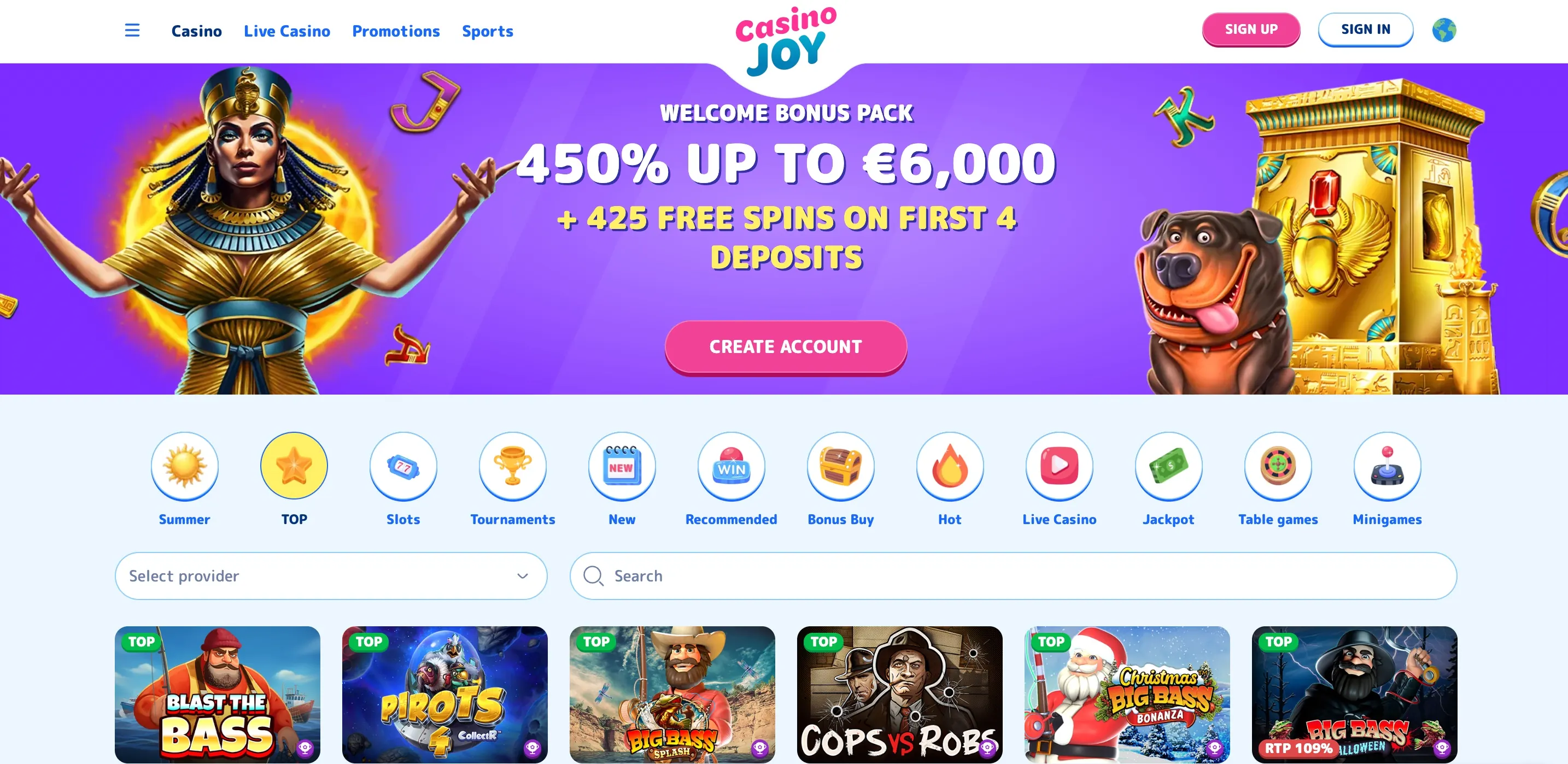
1. CasinoJoy – Published Curaçao Licence and Broad Payments
CasinoJoy is an offshore casino operated by Fortuna Games N.V. Its regulatory information is comparatively easy to identify, with a Curaçao Gaming Authority licence number published for the operator. The casino offers slots, live casino games and multiple payment routes. Identity and customer due diligence checks can apply before withdrawals are approved, so verification should be completed before relying on the stated payout timeframe.
📜 Regulatory Status
Curaçao Gaming Authority, OGL/2024/112/0974
🎁 Bonus Offer
100% up to £500 + 100 free spins
🪪 KYC
CDD and identity checks may apply
💵 Min Deposit
£10
💸 Withdrawal Limit
No fixed cash-balance cap stated
⏱️ Payout Processing
Within 5 working days
💳 Payments
Cards, e-wallets and bank options
Pros & Cons of CasinoJoy
Pros
✓Specific Curaçao licence number published
✓Multiple conventional payment methods
✓Wide slots and live casino selection
Cons
×Not regulated by the UK Gambling Commission
×KYC checks can affect withdrawal timing
×Offshore dispute procedures differ from UKGC casinos
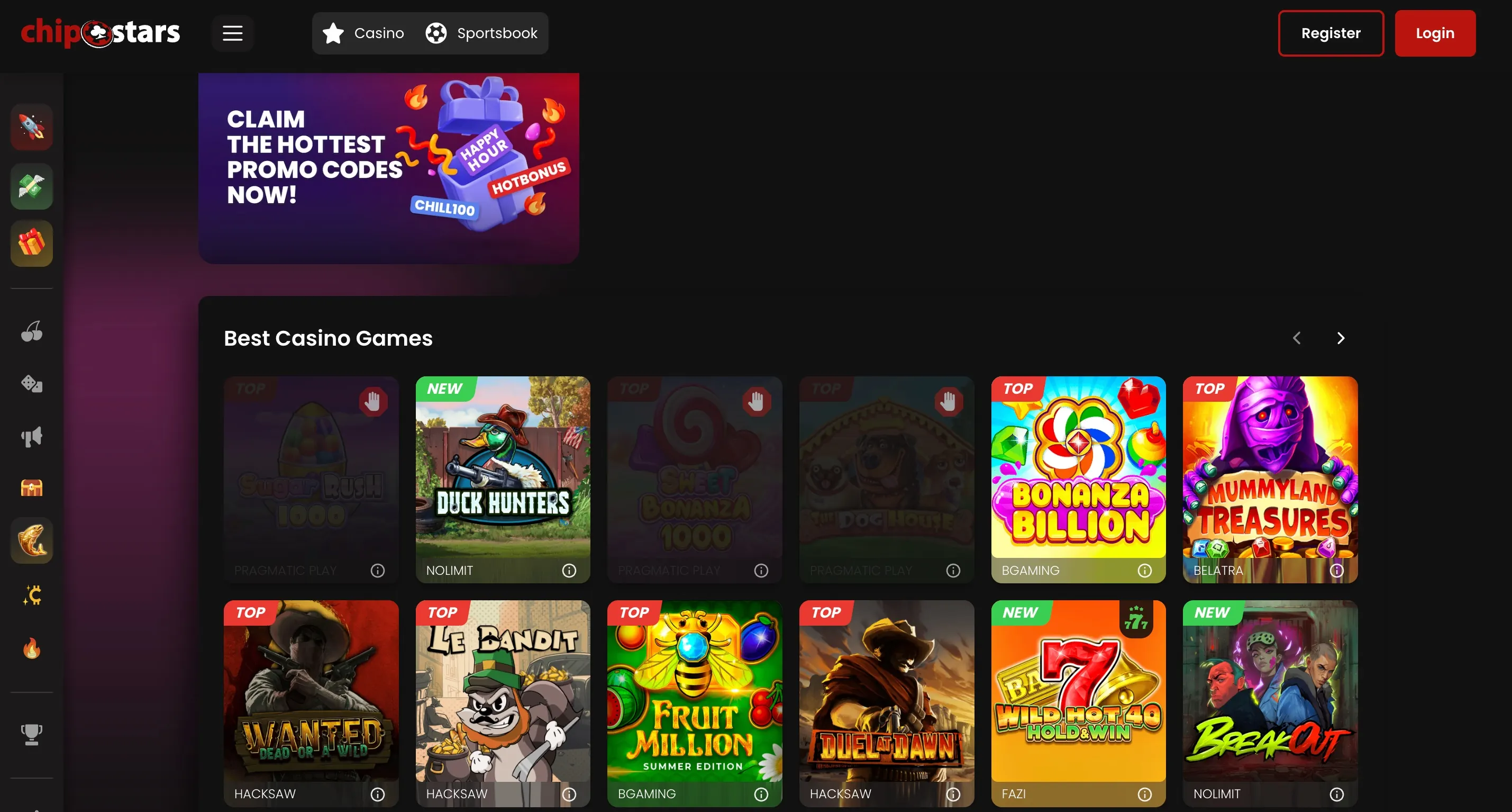
2. Chipstar – High Withdrawal Limits and Multiple Payment Options
Chipstar combines casino games with a comparatively broad cashier and high published withdrawal limits. Its withdrawal policy uses different levels of customer verification depending on transaction size, with enhanced checks for larger cashouts. The operator states that most withdrawals pass through an internal compliance review lasting between automated approval and 96 hours, although additional checks can extend the process.
📜 Regulatory Status
Curaçao-regulated offshore operator
🎁 Bonus Offer
200% up to £400 + 75 free spins
🪪 KYC
Verification level increases with cashout size
💵 Min Deposit
€10 or currency equivalent
💸 Withdrawal Limit
€5,000 daily, €25,000 weekly, €100,000 monthly
⏱️ Payout Processing
Usually 0–96 hours before payment-provider time
💳 Payments
Skrill, Neteller, crypto and other methods
Pros & Cons of Chipstar
Pros
✓High published withdrawal limits
✓Crypto and e-wallet support
✓Detailed withdrawal and verification policy
Cons
×Enhanced checks apply to larger withdrawals
×Compliance reviews can extend payout processing
×No UKGC protection or GAMSTOP participation
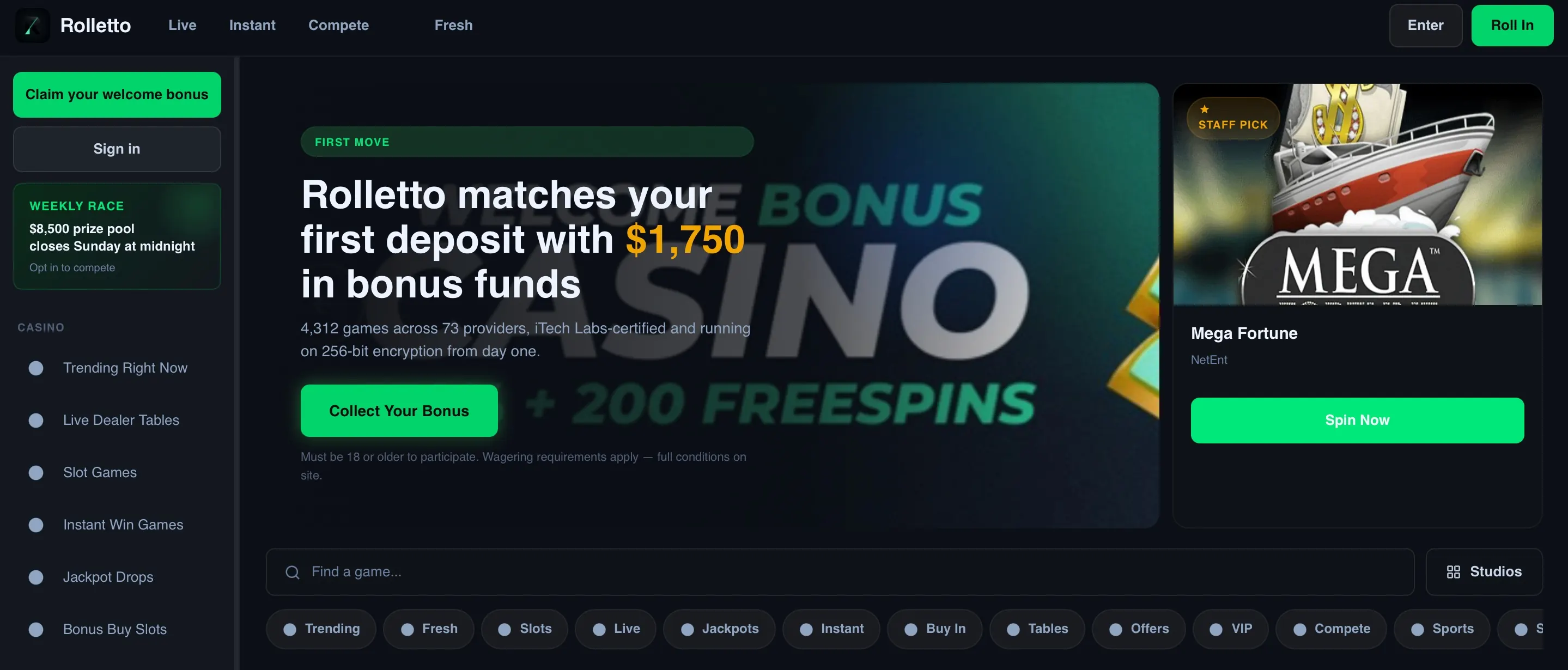
3. Rolletto – Clear Licence and Withdrawal Terms
Rolletto is operated by Santeda International B.V. and publishes a Curaçao Gaming Authority licence number alongside its operator information. Its terms also set clear weekly and monthly cashout limits and state that bank transfer and other payouts are processed within three banking days. Identity checks may be carried out before payment, particularly where account or transaction information needs additional verification.
📜 Regulatory Status
Curaçao Gaming Authority, OGL/2024/1798/1048
🎁 Bonus Offer
100% up to £300 + 120 free spins
🪪 KYC
Identity checks may precede payouts
💵 Min Deposit
€10 or equivalent
💸 Withdrawal Limit
€7,500 weekly, €15,000 monthly
⏱️ Payout Processing
Up to 3 banking days
💳 Payments
Cards, e-wallets, bank and alternative methods
Pros & Cons of Rolletto
Pros
✓Specific regulator and licence number published
✓Weekly and monthly withdrawal limits stated
✓Multiple payment categories available
Cons
×Cashouts above payment-method limits may be split
×Identity checks can temporarily hold withdrawals
×Not covered by UKGC dispute procedures
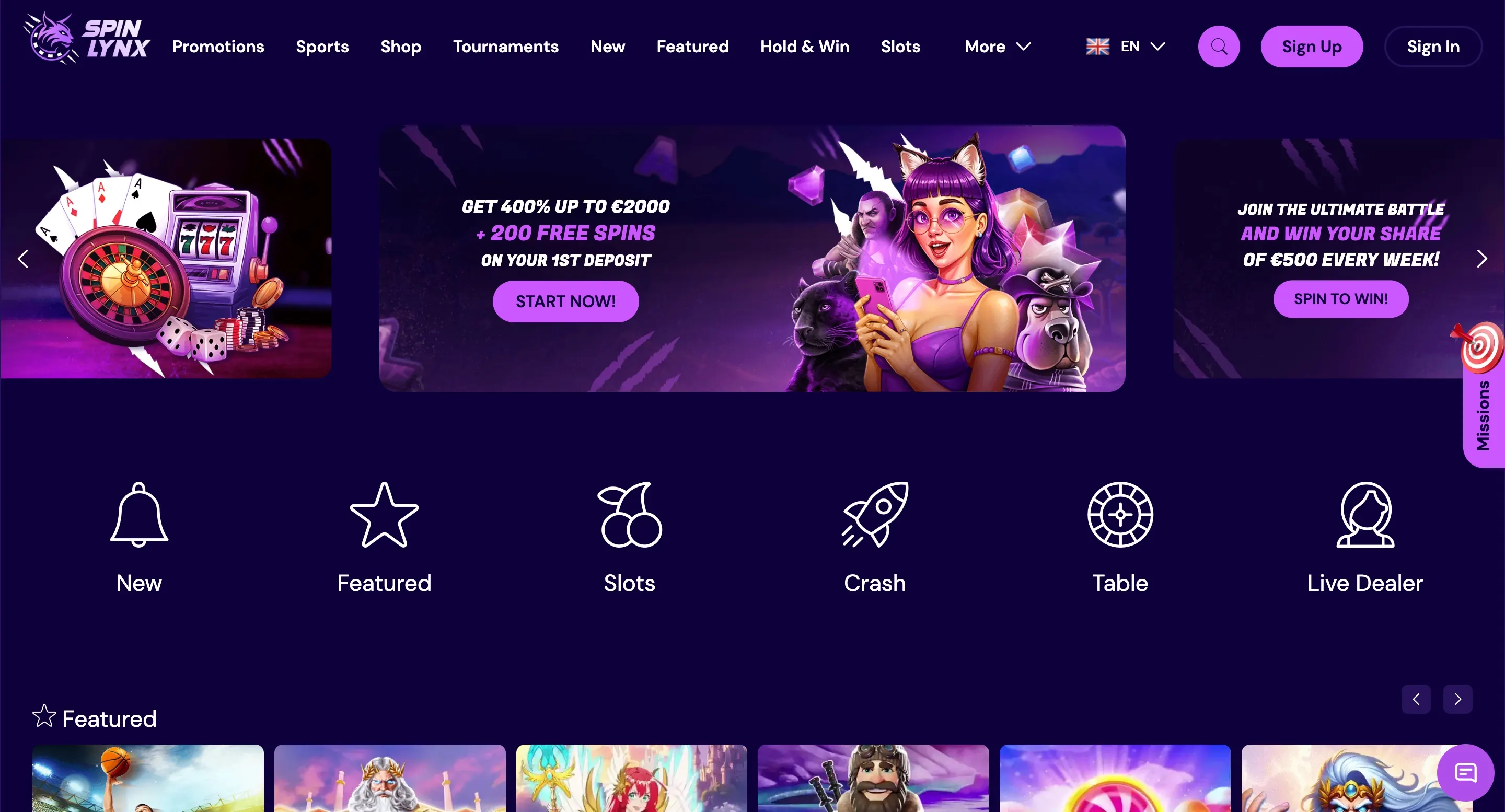
4. SpinLynx – Crypto Payments with Additional Checks Needed
SpinLynx provides card, e-wallet, bank and cryptocurrency payment options, with KYC normally required before the first withdrawal. Public casino information quotes faster processing for cryptocurrency than conventional payment methods. However, its licensing information is difficult to verify independently, and recent public player feedback includes multiple reports of withdrawals taking considerably longer than advertised. These factors make the cashier and regulatory terms particularly important to review before depositing.
Published times vary; longer delays have been reported
💳 Payments
Cards, Skrill, Neteller and major cryptocurrencies
Pros & Cons of SpinLynx
Pros
✓Several cryptocurrency options
✓Cards and e-wallets also supported
✓KYC process is documented before withdrawals
Cons
×Licence information requires additional verification
×Recent player reports describe withdrawal delays
×Withdrawal limits are not consistently published
5. Winplace – Crypto Cashouts and Tiered Withdrawal Limits
Winplace publishes detailed payment information for cards, bank transfers and several cryptocurrencies. Standard withdrawal limits start at £3,000 per week and £15,000 per month, with higher limits linked to lifetime deposit levels. Published payment times vary substantially by method, from near-instant cryptocurrency processing to several banking days for bank transfers. The main point requiring additional scrutiny is regulatory status, as no UKGC licence applies and an independently verifiable gambling licence is not clearly presented.
📜 Regulatory Status
No UKGC licence; offshore licence not clearly verified
🎁 Bonus Offer
200% up to £250 + 80 free spins
🪪 KYC
Verification can be required before payout
💵 Min Deposit
£20
💸 Withdrawal Limit
£3,000 weekly, £15,000 monthly standard
⏱️ Payout Processing
Crypto instant; cards 1–3 days; bank 5–7 days
💳 Payments
Visa, Mastercard, bank transfer and crypto
Pros & Cons of Winplace
Pros
✓Detailed payment processing times
✓Bitcoin, Ethereum, Litecoin and USDT available
✓Higher withdrawal limits for qualifying accounts
Cons
×Regulatory status is less transparent
×Bank transfers can take 5–7 days
×Standard withdrawal limits apply to lower account tiers
6. I24slots – Broad Payments and Restrictive Withdrawal Limits
I24slots provides a wide range of payment options and requires account verification before withdrawals. Its main drawback is the cashout structure: independent reviews currently report a £500 weekly withdrawal limit for standard accounts, which can make larger balances slow to withdraw. Independent licence checks have also been unable to identify a current gambling licence, so regulatory status deserves more attention here than the size of the welcome promotion.
📜 Regulatory Status
No current gambling licence independently identified
🎁 Bonus Offer
150% up to £200
🪪 KYC
Verification required before withdrawals
💵 Min Deposit
Varies by payment method
💸 Withdrawal Limit
£500 weekly at standard levels
⏱️ Payout Processing
0–72 hours pending, then payment-provider time
💳 Payments
Cards, e-wallets and multiple cryptocurrencies
Pros & Cons of I24slots
Pros
✓Wide selection of payment methods
✓Several cryptocurrency options available
✓KYC process is documented for withdrawals
Cons
×Current gambling licence has not been independently identified
×Standard weekly withdrawal limit is comparatively low
×Withdrawal requests can remain pending before processing
How Non GamStop Casinos Work Outside the GAMSTOP System
The main difference is not simply that Non GamStop casinos have fewer restrictions. These operators sit outside the UK Gambling Commission and GAMSTOP framework, which changes how self-exclusion, account controls, complaints, verification and withdrawals are handled. Understanding those differences is more useful than comparing operators only by bonuses or deposit limits.
What GAMSTOP Actually Covers
GAMSTOP is the multi-operator online self-exclusion scheme used by gambling businesses licensed in Great Britain. When someone registered with GAMSTOP attempts to open or access an account with a participating operator, their registration details are checked against the self-exclusion system.
All online gambling companies licensed in Great Britain must participate in GAMSTOP. This means a genuine Non GamStop casino is not a UKGC-licensed casino operating outside the scheme by exemption. It is an operator outside the UKGC framework, normally relying on an overseas licence or another international operating structure.
This distinction matters because an offshore casino does not automatically inherit UKGC rules on self-exclusion, complaints, customer protection or account management. The relevant requirements instead depend on the operator, its licensing jurisdiction and its own terms.
What Changes Outside the GAMSTOP Framework
The practical differences go beyond whether a GAMSTOP check takes place. Before using an offshore casino, it is worth comparing how several important account protections are handled.
Area
UKGC-Licensed Casino
Non GamStop Casino
GAMSTOP
Participation required
Outside the GAMSTOP network
Regulatory Oversight
UK Gambling Commission
Depends on offshore jurisdiction
Self-Exclusion
GAMSTOP plus operator controls
Operator or regulator-specific tools
Complaint Route
Internal complaint process and approved ADR
Depends on operator and licensing authority
KYC Checks
UKGC framework applies
Requirements vary by licence and operator
Withdrawal Rules
UK-regulated account and payment rules
Operator-specific limits and processing terms
For that reason, phrases such as “no restrictions” or “no verification” can be misleading. An offshore operator may still require identity documents, proof of address, payment verification or source-of-funds information. It may also impose weekly or monthly withdrawal limits that are more restrictive than those found at some UK-regulated casinos.
What Happens if You Are Already Self-Excluded
A current GAMSTOP exclusion cannot be cancelled early. Choosing an offshore casino does not remove or modify that exclusion, and it should not be treated as an alternative route for overriding a self-exclusion decision.
Check your exclusion period. GAMSTOP currently offers minimum periods of six months, one year, five years or five years with auto-renewal.
Do not attempt early removal. An active minimum exclusion period must run to completion before a removal request can be made.
Use the official removal process after expiry. An exclusion does not disappear automatically when the minimum period ends. Removal must be requested through GAMSTOP, followed by a minimum 24-hour cooling-off period.
Keep protection in place if it is still useful. If gambling is causing financial or personal harm, maintaining self-exclusion and using additional blocking or support services is safer than opening another gambling account.
For players who are not currently self-excluded, the main task when comparing Non GamStop casinos is different: verify the operator, licence, KYC policy, withdrawal limits, complaint route and responsible gambling controls before sending money or personal documents.
How Registration and KYC Work at Non GamStop Casinos
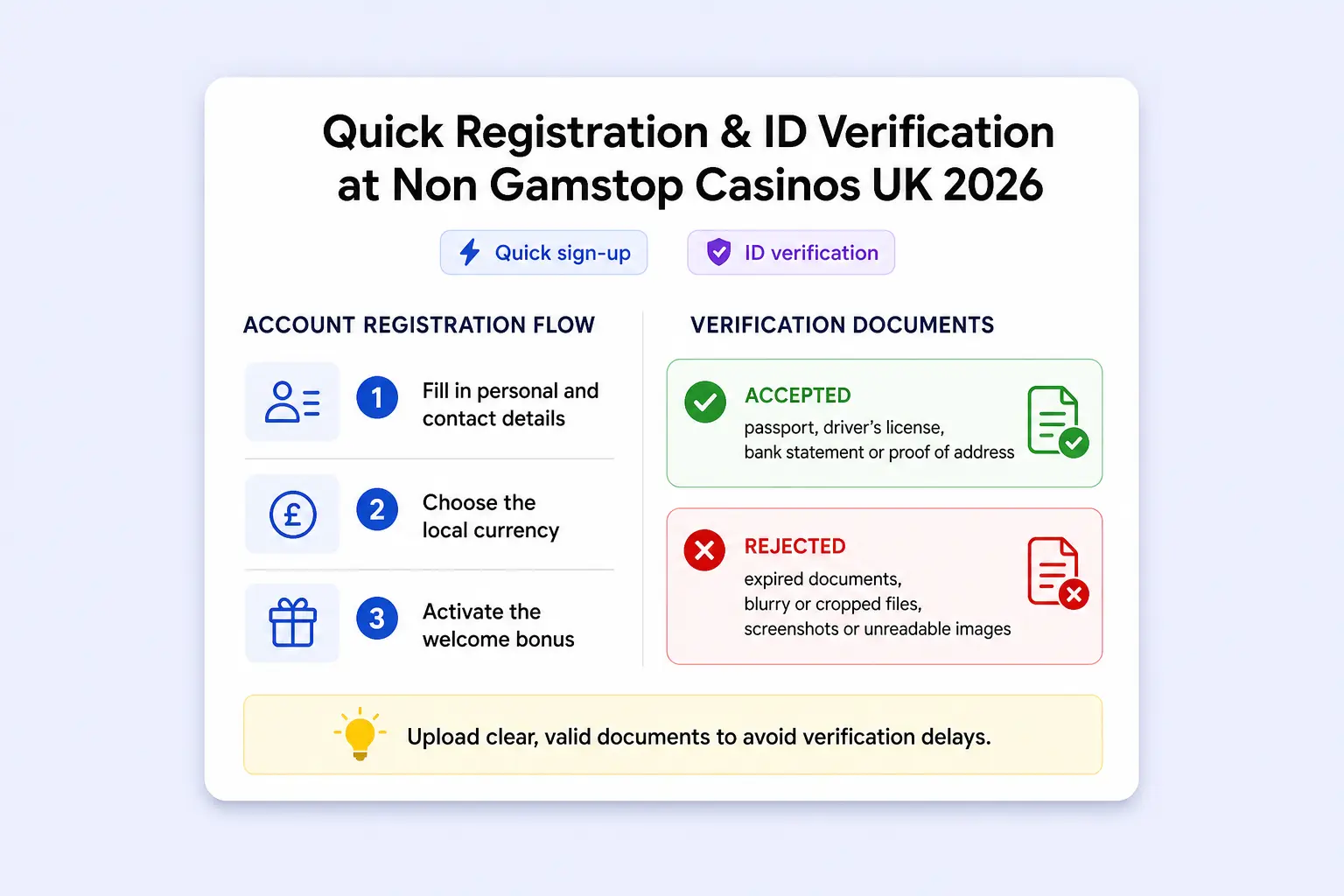
Registration at a Non GamStop casino can differ from the process used by UKGC-licensed sites. Some offshore operators complete identity checks during sign-up, while others request documents before a withdrawal, after certain transaction levels, or when account activity triggers additional checks. The important point is to understand the operator’s jurisdiction, eligibility rules and verification policy before depositing.
1
Step 1: Check Eligibility Before Opening an Account
Before entering personal details, check who operates the casino, which regulator or jurisdiction is stated, and whether your country is accepted. A Non GamStop casino sits outside the UKGC and GAMSTOP framework, but that does not automatically mean every offshore site accepts players from every location.
Read the restricted-country section of the terms rather than relying only on a homepage or promotional page. Some operators may display GBP, English-language content or familiar payment methods while still excluding particular jurisdictions from real-money play.
Use your correct legal name, date of birth, residential address and contact details. Account information normally needs to match any identity documents and payment methods later submitted for verification. Incorrect or inconsistent details can result in additional checks or a suspended withdrawal.
Do not use another person’s identity, payment account or false location information to bypass an operator’s eligibility rules. If the casino does not accept players from your location under its current terms, registration should not be treated as a way around that restriction.
Before depositing, also check the minimum deposit, supported currencies, withdrawal limits, available payment methods and whether the operator requires withdrawals to return through the original deposit method. These conditions can be more important at an offshore casino than the headline size of its welcome offer.
2
Step 2: Understand When KYC May Be Required
Non GamStop does not necessarily mean no verification. Offshore casinos can still use Know Your Customer and anti-money-laundering checks, but the timing and required documents depend on the operator, licensing jurisdiction, transaction history and risk controls.
Common identity documents include a valid passport, national identity card or driving licence. Proof of address may include a bank statement, utility document or another record accepted by the operator. The casino may also request confirmation that the payment method belongs to the registered account holder.
Additional checks can be triggered by a withdrawal, larger transaction volumes, changes in payment method, mismatched account information or activity that requires enhanced customer due diligence. In some cases, an operator may request a selfie, live identity check or evidence relating to the source of deposited funds.
Marketing phrases such as “no KYC” or “instant registration” should therefore be read carefully. They may mean that documents are not required at the initial sign-up stage, rather than guaranteeing that the casino will never request identity or financial information.
Before making a substantial deposit, check whether the casino publishes its KYC procedure and what happens to withdrawals while verification is pending. A clearly explained document process, expected review stages and accessible support are more useful signals than a promise of completely anonymous play.
Submit documents only through the operator’s official secure verification channel. Files should be current, readable and unedited, and the information should match the casino account. If additional documents are requested, ask what requirement they are intended to satisfy and keep a record of the correspondence until the account review is complete.
How Payouts Work at Non GamStop Casinos
A fast withdrawal claim does not always mean the money reaches the player immediately. At Non GamStop casinos, a cashout may pass through an internal pending period, KYC review and payment-provider processing before the funds arrive. We therefore compare the published payout stages, withdrawal limits and verification conditions rather than ranking casinos by a single headline speed.
Published Processing Times, KYC and Withdrawal Limits
Casino
Internal Review / Pending
Payment Time
Withdrawal Limit
What Can Delay a Payout
CasinoJoy
24–96 hours
E-wallets: 0–24 hours Cards: 3–5 days Bank: 3–7 days
€500 daily €3,500 weekly €15,000 monthly
Pending review, KYC or payment-provider processing
Chipstar
0–96 hours in standard cases
Depends on payment method after approval
€5,000 daily €25,000 weekly €100,000 per 30 days
Enhanced verification or source-of-wealth checks on larger withdrawals
Rolletto
Included within stated processing period
Up to 3 banking days
€7,500 weekly €15,000 monthly
Identity review or payment-method limits
SpinLynx
Up to 48 hours
Bank transfer: 3–10 banking days Crypto may be faster after approval
Depends on current account and cashier terms
KYC, weekends and additional document requests
Winplace
Method-dependent
Crypto: instant Cards: 1–3 days Bank: 5–7 days
Up to £/€4,000 per transaction
Payment method, verification and banking processing
I24slots
0–72 hours
Cards, e-wallets and bank: up to 3 banking days
€/$500 weekly at lower VIP levels Up to €/$1,500 weekly at higher levels
KYC and the casino-side pending period
The most important distinction is between casino processing time and the time it takes for money to arrive. A casino may describe a payment method as instant even though the withdrawal first remains pending for account checks. Only after approval does the payment provider, card network, bank or blockchain handle the transfer.
KYC can therefore matter more than the advertised payment speed. Chipstar, for example, uses different verification levels as withdrawal amounts increase, while Rolletto reserves the right to hold a withdrawal while identity checks are completed. At other operators, the first withdrawal may not be released until the account and payment method have been verified.
Withdrawal limits are another important Non GamStop-specific comparison point. A fast payment method offers limited practical benefit if a casino releases only a small part of a larger balance each week. Chipstar publishes substantially higher cashout ceilings than I24slots, while Rolletto uses defined weekly and monthly limits. These restrictions should be checked before depositing, particularly when playing with larger balances.
Crypto can shorten the payment-provider stage but does not automatically remove casino-side checks. Winplace lists cryptocurrency withdrawals as instant, while SpinLynx publishes a pending period that can still apply before a transaction is released. Network confirmation times, wallet details and verification can add further delays.
For that reason, we do not treat “instant payout” as a pass-or-fail rating. A more useful comparison is whether the operator clearly states its pending period, verification requirements, withdrawal limits and expected payment time. Those details show how a cashout is likely to work before a player commits funds.
How We Evaluate Non GamStop Casinos
Non GamStop casinos require a different review process from UKGC-licensed sites. We place the greatest weight on operator identity, offshore licensing, player eligibility, KYC and withdrawal rules, self-exclusion options, and complaint procedures. Bonuses, games and mobile usability are assessed only after these higher-risk areas have been checked.
Our Seven Checks for Casinos Outside GAMSTOP
We do not treat being outside GAMSTOP as a positive rating factor. GAMSTOP participation is required for online operators licensed in Great Britain, so a genuine Non GamStop casino sits outside that UKGC framework. Our review therefore starts by identifying what regulatory and player-protection structure applies instead.
Operator, licence and jurisdiction. We identify the legal company behind the casino, check the regulator named on the site, look for a licence number where one is provided, and compare those details with the relevant regulator or public records. A generic statement such as “internationally licensed” is not treated as sufficient evidence.
Player eligibility and restricted countries. We read the operator’s terms to establish which jurisdictions it accepts. Displaying GBP, English-language pages or UK-focused promotions does not by itself confirm that players in Great Britain are permitted under the operator’s current terms. Availability is also different from UKGC authorisation.
KYC and account verification. We check when identity verification can occur, which documents may be requested, whether payment ownership is verified, and whether enhanced checks can be triggered by larger deposits or withdrawals. Claims such as “no KYC” receive additional scrutiny because document checks may still appear later in the account lifecycle.
Withdrawal rules and access to balances. We examine casino-side pending periods, payment processing times, minimum cashouts, weekly or monthly withdrawal limits, verification holds and any rules allowing large withdrawals to be split into instalments. We separate internal approval time from the time required by a bank, card provider, e-wallet or blockchain.
Self-exclusion and player controls. Because these casinos are outside the GAMSTOP network, we check what alternative controls the operator provides. This can include account self-exclusion, deposit limits, loss limits, session controls, cooling-off tools and links to external gambling-support services. We also check how easily these controls can be activated and whether the terms explain how long exclusions remain in force.
Complaints and dispute resolution. We establish how a complaint is submitted, which company receives it, whether the operator names an independent dispute body or regulator, and what escalation options exist if a withdrawal or account dispute is unresolved. Offshore complaint routes can differ substantially between jurisdictions, so this carries more weight in our Non GamStop reviews than general customer-service response time.
Bonus, payments and casino product. Only after the checks above do we assess promotional value, wagering requirements, payment selection, crypto support, game providers, mobile usability and customer support. These features can improve convenience, but they do not compensate for unclear ownership, unverifiable licensing or restrictive withdrawal terms.
Not every criterion has equal importance. A large bonus, extensive game catalogue or fast payment method cannot offset serious uncertainty about who operates the casino, how withdrawals are controlled or where a player can escalate a dispute.
We distinguish between verified information, operator claims and details that could not be independently confirmed. Licence numbers, ownership information, withdrawal rules and restricted-country terms are checked first. Where public information conflicts or a regulatory claim cannot be verified, that uncertainty is reflected in the review rather than replaced with a generic “licensed” label.
Commercial relationships do not determine the conclusions of our reviews. Affiliate status does not change the criteria applied to an operator, and material disadvantages such as low withdrawal limits, unclear licensing, restrictive KYC rules or weak complaint procedures remain part of the assessment.
We also revisit reviews when material conditions change. Offshore licences, ownership, payment methods, withdrawal limits, restricted countries and bonus rules can change over time, so the rating should reflect the current operator rather than historical promotional information.
How Offshore Casino Licences Compare with UKGC Regulation
A licence from Malta, Curaçao or Anjouan is not equivalent to a UK Gambling Commission licence. The main differences concern where an operator may legally offer gambling, how player funds are protected, what responsible gambling requirements apply and where a dispute can be escalated. For Non GamStop casinos, checking the actual licence holder and permitted jurisdictions is especially important.
UKGC, MGA, Curaçao and Anjouan Compared
Regulatory Framework
Great Britain Access
Player Protection
Complaint and Dispute Route
UK Gambling Commission
Required for operators offering remote gambling to consumers in Great Britain
UKGC rules, GAMSTOP participation, KYC, responsible gambling and technical standards
Operator complaint process followed by an approved ADR provider
Malta Gaming Authority
An MGA licence alone does not authorise gambling services in Great Britain
Player funds must remain segregated and separately identifiable; responsible gambling and self-exclusion rules apply
Operator complaint process followed by the operator's appointed ADR entity
Curaçao Gaming Authority
A Curaçao licence alone does not replace the UKGC licence required to serve Great Britain
Current rules cover segregated player funds, KYC, responsible gambling, game certification and account controls
Operator complaint procedure with access to independent ADR
Anjouan Gaming Authority
Current licence validation notices list the United Kingdom as an excluded territory
Licence status can be checked through the public register; operator-level controls depend on applicable licence conditions
Complaint to the operator first, followed by the applicable independent ADR process
The most important distinction is territorial. An offshore licence may be valid in its issuing jurisdiction without giving the operator permission to offer remote gambling in Great Britain. The UK Gambling Commission states that businesses providing remote gambling to consumers in Great Britain require the appropriate UKGC operating licence, regardless of where the company itself is based.
This is why a licence badge should not be interpreted simply as “approved for UK players”. The regulator, legal entity, licence number, domain and territorial restrictions should be checked separately. For Non GamStop casinos, these details provide much more useful information than a generic claim that the site is “internationally licensed”.
How Dispute Routes Differ Between Licensing Jurisdictions
The correct escalation route depends on the licence governing the casino. Before submitting a complaint, identify the legal operator and verify that the casino domain is actually covered by the licence being displayed. A licence belonging to a related company or another domain should not be treated as proof that the site itself is authorised.
Start with the casino's formal complaints procedure. Describe the disputed transaction or account decision, include relevant dates and amounts, and request a written response. Keep the complaint separate from ordinary live-chat conversations where possible.
Check the applicable external dispute route. UKGC-licensed operators must provide access to an approved ADR provider when an eligible dispute remains unresolved. MGA operators are also required to appoint an ADR entity for player disputes.
For Curaçao casinos, check the current licence and ADR details. Current Curaçao Gaming Authority licence conditions require licensed operators to maintain a complaints procedure and provide independent ADR. The operator's terms should explain how an unresolved complaint can be escalated.
For Anjouan licences, verify territorial eligibility first. The current public register can be used to check company, licence and domain information, but current Anjouan validation notices identify the United Kingdom as an excluded territory. This is particularly important before relying on an Anjouan licence for a UK-facing casino claim.
Keep evidence from the start. Save the applicable terms, withdrawal request, transaction records, KYC requests, account notices and relevant correspondence. These records can be important if the operator changes its terms or an external dispute body later asks for a chronology of the case.
Regulators also perform different functions. The UK Gambling Commission supervises licensed operators but does not normally decide individual payout disputes itself. Similarly, the MGA distinguishes regulatory complaints from disputes that should be handled by an ADR entity. The existence of a regulator therefore does not mean that the regulator acts as a personal gambling ombudsman.
How Bonus Wagering Works at Non GamStop Casinos
Bonus conditions at offshore casinos can differ significantly from those used by UKGC-licensed operators. The headline percentage is only one part of the offer. Wagering multiples, the balance used in the calculation, game contribution, maximum stakes, withdrawal caps and expiry rules can all change how much play is required before bonus-related funds become withdrawable.
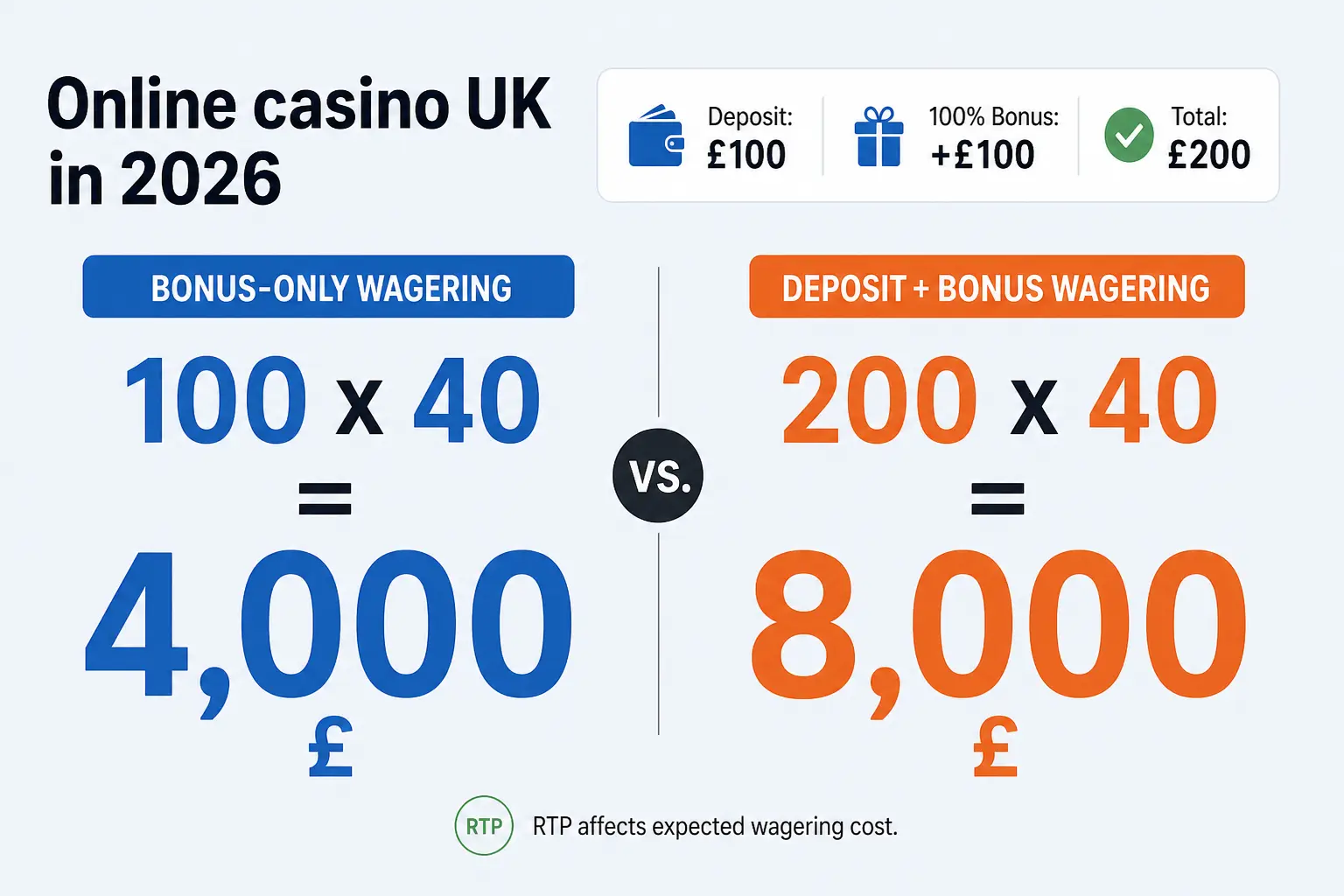
Why a 40x Wager Can Mean £4,000 or £8,000
The first detail to check is what the wagering multiple applies to. Some offshore promotions calculate turnover using bonus funds only, while others apply the same multiplier to the combined deposit and bonus balance. Two offers displaying the same 40x requirement can therefore produce very different turnover totals.
Example deposit:
£100 deposit + 100% bonus = £200 total starting balance.
These figures are illustrative rather than a recommended level of play. For a Non GamStop casino, the terms should state clearly whether the calculation uses the bonus, deposit and bonus, or another qualifying balance. If the wording is unclear, the requirement should be confirmed before activating the promotion.
This is also an important regulatory difference. Since 19 January 2026, UKGC-licensed operators cannot apply wagering requirements above 10x bonus funds. That UKGC cap should not automatically be applied to offshore casinos, which follow the rules of their own licensing jurisdiction and promotion terms. A casino claiming to be UKGC-licensed while simultaneously advertising a 40x or 50x bonus requirement would therefore warrant additional checking.
Bonus Terms That Can Increase the Real Wagering Burden
The multiplier alone does not show how restrictive an offshore bonus is. Several additional conditions can determine whether the wagering target is practical and what happens to the balance before or after it is completed.
Bonus Term
What to Check
Why It Matters
Wagering Base
Bonus only or deposit + bonus
Can substantially change total required turnover
Game Contribution
100%, reduced contribution or excluded games
Not every stake may count equally
Maximum Bet
Maximum permitted stake while wagering
Exceeding it may breach bonus terms
Expiry Period
Time allowed to complete wagering
Unfinished bonus balances may expire
Maximum Cashout
Any cap on bonus-derived withdrawals
A completed wager may still have a payout ceiling
Payment Restrictions
Excluded e-wallets, crypto or deposit methods
Some payment methods may not qualify for the offer
Bonus Cancellation
What happens when withdrawing early
Bonus funds or related winnings may be removed
Game contribution deserves particular attention. A slot may contribute 100% of each qualifying stake, while a table game could contribute only a fraction or nothing at all. This means the amount wagered and the amount credited towards the requirement are not always the same.
Maximum cashout clauses are especially relevant at some offshore casinos. Completing a wagering requirement does not necessarily mean the entire resulting balance can be withdrawn if the promotion imposes a separate winnings cap. That condition should be checked alongside the casino's normal daily, weekly or monthly withdrawal limits.
Non-Sticky Bonuses and Early Withdrawals
A non-sticky bonus separates real-money funds from promotional funds more clearly than a conventional locked bonus. Depending on the terms, the player may be able to withdraw an untouched cash deposit without first completing the bonus wagering requirement, while forfeiting the bonus and any winnings attached to it.
However, the label “non-sticky” is not enough on its own. Check when bonus money becomes active, whether real-money funds are used first, what happens to winnings after the bonus balance is activated, and whether requesting a withdrawal automatically cancels the promotion.
Some offshore offers also distinguish between cash balance, bonus balance and bonus-derived winnings. Those balances may be subject to different withdrawal, expiry or maximum-cashout rules, so the relevant section of the terms should be read before relying on the promotional headline.
RTP Does Not Remove the Cost of Wagering
RTP is a theoretical long-term percentage for a game rather than a prediction of what will happen while completing one bonus. A 96% theoretical RTP does not mean that £4,000 of required wagering will reliably return 96% of that amount during an individual session.
Variance, game contribution and the size of the wagering requirement all affect the outcome, and there is no guaranteed method for completing a bonus without loss. For comparison purposes, the more useful question is whether the casino presents the wagering base, eligible games, maximum bet, expiry period and withdrawal restrictions clearly before the promotion is accepted.
Are Non GamStop Casinos Legal in the UK?
For players in England, Scotland and Wales, the key legal question is whether the operator is authorised to provide remote gambling in Great Britain. An overseas casino licence does not replace a UK Gambling Commission licence. This distinction is essential when assessing Non GamStop casinos, because genuine operators outside GAMSTOP are also outside the UKGC licensing framework.
What UK Law Requires from Offshore Casino Operators
A remote gambling business needs the appropriate UK Gambling Commission operating licence if it provides gambling facilities to consumers in Great Britain. This requirement applies even when the company, servers or gambling licence are based overseas.
A Malta, Curaçao or other international licence may authorise the operator under the rules of that jurisdiction, but it does not by itself authorise the casino to provide gambling to consumers in Great Britain. The UK Gambling Commission describes gambling supplied to consumers in Great Britain without the required operating licence as unlawful gambling.
GAMSTOP status follows the same regulatory distinction. Online gambling operators licensed in Great Britain are required to participate in GAMSTOP. A genuine Non GamStop casino should therefore not be presented as a UKGC-licensed casino with an exemption from the scheme. It operates outside the UKGC and GAMSTOP framework.
Operator Status
Can the Licence Authorise GB Gambling?
GAMSTOP
UKGC Consumer Framework
UKGC-Licensed Casino
Yes, for the activities covered by its licence
Participation required
Applies
MGA-Licensed Casino Only
No, an MGA licence alone is insufficient
Not automatically covered
Does not apply through the MGA licence
Curaçao-Licensed Casino Only
No, a Curaçao licence alone is insufficient
Not automatically covered
Does not apply through the Curaçao licence
Other Offshore Licence Only
No, an overseas licence alone is insufficient
Depends on the operator and jurisdiction
Does not replace UKGC protection
For this reason, the first legal check is not whether a casino displays any licence badge. It is whether the operator and domain appear on the UK Gambling Commission Public Register when the site claims to be authorised for Great Britain. The legal company name, trading names, domain and licence status should correspond with the register entry.
What Using an Offshore Casino Changes for the Player
The regulatory issue should be separated from the player's own account activity. UKGC guidance focuses on the legality of providing gambling facilities to consumers without the required licence. For the player, the practical concern is that using an offshore operator can place the account outside protections attached to UKGC-regulated gambling.
This can affect how withdrawals, complaints, self-exclusion and account disputes are handled. At a UKGC-licensed casino, the operator must maintain a formal complaints procedure and provide access to an approved independent ADR provider when an eligible dispute remains unresolved. An offshore casino follows the dispute system established by its own licence and terms, which may offer a different level of practical recourse.
The same distinction applies to player funds and account controls. UKGC-licensed businesses must disclose how customer funds are protected if the business becomes insolvent. Offshore casinos may use different safeguarding arrangements, so the operator's terms should explain whether player balances are segregated or otherwise protected.
Before depositing at a Non GamStop casino, check at least the following:
the legal company operating the casino;
the regulator and current licence number;
whether the casino's terms permit players from your location;
KYC and source-of-funds requirements;
daily, weekly and monthly withdrawal limits;
the casino's complaint and external dispute route;
available account limits and self-exclusion tools.
A casino being accessible from Great Britain, accepting GBP or displaying UK-oriented content does not prove that it holds UKGC authorisation. Availability, offshore licensing and legal permission to provide gambling in Great Britain are separate issues.
Why an Offshore Licence Is Not a UK Licence
International regulators should be assessed on their own rules rather than ranked with labels such as “maximum safety” or “weak protection”. The relevant questions are what the licence actually covers, whether it is current, which domain and company it belongs to, what player-fund requirements apply and how unresolved disputes can be escalated.
An MGA or Curaçao licence can provide genuine regulatory oversight within its applicable framework, but neither substitutes for UKGC authorisation where UK law requires it. Likewise, the presence of KYC, responsible gambling controls or certified games does not change the operator's licensing status in Great Britain.
This is particularly important on a Non GamStop page. “Licensed offshore” should describe the operator's regulatory jurisdiction accurately, not imply that the casino has regulatory approval to serve Great Britain when no UKGC licence exists.
How Payments and Withdrawals Work at Non GamStop Casinos
Banking at an offshore casino should be checked from both directions. A method that works for deposits may not support withdrawals, and the fastest payment rail can still be delayed by casino-side approval, KYC or withdrawal limits. Before funding an account, compare the cashier rules rather than relying on payment logos or an advertised “instant payout” claim.
Deposit Methods Do Not Always Match Withdrawal Options
Non GamStop casinos may offer debit cards, bank transfers, e-wallets, prepaid methods and cryptocurrency, but availability can change by operator, currency and player location. A payment logo on the deposit screen does not necessarily mean the same method can receive a withdrawal.
Before depositing, check the cashier for four separate details: the minimum deposit, minimum withdrawal, maximum transaction and whether withdrawals must return to the original funding method. Some operators also divide larger balances into weekly or monthly instalments, making the overall withdrawal limit more important than the maximum size of one transaction.
Payment ownership also matters. Casinos can request evidence that a card, bank account, e-wallet or crypto wallet belongs to the registered player. Using another person's payment account can trigger additional checks or prevent a withdrawal from being approved.
Credit cards illustrate one of the regulatory differences between offshore and UKGC-regulated gambling. UKGC-licensed operators cannot accept credit card gambling payments in Great Britain, including payments routed through an e-wallet funded by a credit card. An offshore casino showing a credit card option therefore should not be assumed to follow the same payment framework as a UKGC-licensed operator.
E-Wallet and Crypto Cashouts Need Separate Checks
E-wallets can reduce the amount of card information entered directly into a casino cashier and may settle quickly after the operator releases a withdrawal. However, PayPal, Skrill, Neteller and similar services are not universally available at offshore casinos, and some operators allow them for deposits but restrict withdrawals or bonus eligibility.
Crypto payments introduce a different set of checks. Bitcoin, Ethereum, USDT and other assets can move without conventional bank settlement, but the transaction may still remain pending while the casino reviews the account. Non GamStop does not mean anonymous: identity, payment ownership or source-of-funds checks can still apply.
Payment Factor
E-Wallets
Crypto
Casino Approval
Required before payout
Required before blockchain transfer
KYC
May be required
May still be required
Transfer Costs
Operator or wallet fees may apply
Network and conversion costs may apply
Currency Risk
Possible FX conversion
Possible crypto price and FX conversion
Incorrect Details
May delay or reject payment
Incorrect wallet transfers can be irreversible
Stablecoins can reduce price movement relative to assets such as Bitcoin, but they do not remove network fees, wallet-address risk or casino verification. The relevant network should also be checked carefully because the same token can exist on several blockchains and an unsupported transfer route can result in lost funds.
Check the Full Withdrawal Route Before Depositing
The useful payout figure is the complete withdrawal journey, not the shortest number displayed beside a payment logo. An offshore cashout can include several separate stages:
Withdrawal request. Check the minimum amount, transaction cap and any daily, weekly or monthly limit.
Casino-side pending period. Some operators review a request for several hours or days before releasing it to the payment provider.
KYC or payment verification. Identity, address, payment ownership or additional financial information may be requested depending on the account and transaction.
Bonus review. An active promotion can introduce wagering, maximum-bet, game-contribution or maximum-cashout conditions that must be resolved before withdrawal.
Payment-provider settlement. Only after casino approval does the bank, card network, e-wallet or blockchain complete its part of the transfer.
This distinction is particularly important when a casino advertises “instant withdrawals”. The payment method itself may be capable of instant settlement while the operator still applies a pending period or verification review beforehand.
Before making a larger deposit, compare the published withdrawal ceiling with the amount you may realistically want to cash out. A £500 weekly limit can matter more than whether an e-wallet settles in minutes, while a higher-limit operator may be more practical even if the final bank transfer takes several days.
Banking Details Worth Checking Before the First Deposit
Confirm that the payment method supports both deposits and withdrawals.
Check minimum and maximum transaction amounts separately.
Look for daily, weekly and monthly withdrawal ceilings.
Separate casino pending time from payment-provider processing time.
Check whether KYC must be completed before the first cashout.
Confirm whether the payment account must be in the same name as the casino account.
Review currency conversion, operator, wallet and blockchain fees.
Check whether a bonus excludes the chosen payment method.
Verify the correct blockchain and wallet address before a crypto transfer.
Keep withdrawal confirmations and transaction references until the payment arrives.
If the cashier does not clearly explain withdrawal limits, verification stages or processing times before a deposit is made, that lack of transparency should be treated as part of the casino assessment rather than discovered only after a cashout is requested.
Are Non GamStop Casino Winnings Taxable?
For individual players in the UK, casino winnings are generally not subject to Income Tax or Capital Gains Tax simply because they came from gambling. Using an offshore or Non GamStop casino does not by itself change that treatment, although large transfers, cryptocurrency withdrawals and income earned around gambling can create separate record-keeping or tax considerations.
Casino Winnings Are Generally Tax-Free for Players
HMRC's general position is that betting and gambling by an individual do not constitute a trade. This means ordinary casino winnings are generally outside Income Tax, and betting, lottery and gaming winnings are also excluded from Capital Gains Tax.
There is no special tax-free winnings threshold that suddenly makes a large casino cashout taxable. A £500 withdrawal and a much larger genuine gambling win are not separated by an HMRC threshold for gambling winnings. The size of a payment can, however, result in additional questions from a bank, payment provider or compliance team about where the funds came from.
Situation
Typical UK Tax Position
Casino cash winnings
Generally not taxable
Regular or frequent gambling wins
Frequency alone does not make them taxable
Person who earns a living from betting
Gambling alone does not automatically constitute a trade
Winnings from an offshore casino
Offshore licence alone does not change the basic player tax treatment
Separate payments for gambling-related services
May be taxable depending on the nature of the income
Crypto received and later disposed of
A later cryptoasset gain may create a Capital Gains Tax issue
The same principle applies to someone who gambles frequently or successfully. HMRC specifically states that having a betting system, gambling systematically or even earning a living from gambling is not enough by itself to establish a taxable gambling trade.
Offshore Withdrawals Can Still Trigger Financial Checks
Tax-free does not mean documentation-free. This distinction is particularly relevant to Non GamStop casinos because funds may arrive from an overseas operator, payment processor, e-wallet or crypto wallet rather than a familiar UK-regulated casino payment route.
A bank or payment provider may ask for evidence explaining an unusual or substantial incoming transfer as part of its anti-money-laundering and fraud controls. That does not mean HMRC has imposed a gambling winnings tax or that the payment has become taxable.
Keeping a clear transaction trail can make the source of funds easier to demonstrate. Useful records include:
casino account and transaction history;
original deposit confirmations;
withdrawal requests and approval emails;
bank or e-wallet statements showing the payment;
the operator's legal company name and domain;
relevant bonus or withdrawal terms;
crypto transaction IDs and wallet records where applicable.
Records can be particularly useful where the name of the company sending the payment differs from the casino brand displayed on the website, which can occur when offshore operators use separate payment-processing companies.
Crypto Casino Winnings Need an Extra Tax Check
A gambling win does not automatically become ordinary taxable income because the casino pays it in Bitcoin, Ethereum, USDT or another cryptoasset. The important distinction is what happens to the crypto after it has been received.
HMRC treats cryptoassets as chargeable assets for Capital Gains Tax purposes. Selling tokens for pounds, exchanging one token for another, spending them on goods or services, or giving them away in many circumstances can constitute a disposal.
This means the original gambling result and a later movement in the value of the crypto should not be treated as the same event. A player who keeps crypto received from a casino and later disposes of it may need to consider whether a chargeable crypto gain has arisen.
Keep the date, token type, amount, sterling value, wallet transaction and later disposal records. Crypto tax depends on the individual circumstances and subsequent transactions, so larger or unusual cases may justify professional tax advice.
Player Tax and Casino Gambling Duties Are Different
The tax treatment of the player should not be confused with taxes imposed on gambling businesses. Operators can have UK gambling-duty obligations even though individual gambling winnings are generally not taxed.
HMRC states that businesses offering remote gaming to people who usually live in the UK can be required to register for and pay UK gambling duties regardless of whether the business itself is based inside or outside the UK. From 1 April 2026, the Remote Gaming Duty rate is 40%.
That duty is imposed on the gambling business rather than being a 40% tax deducted from a player's casino win. Likewise, whether an offshore operator is meeting its own UK tax or regulatory obligations should not be confused with whether an individual player owes Income Tax on a genuine gambling payout.
When Gambling-Related Income Can Be Taxable
Separate commercial income can still be taxable even when gambling winnings themselves are not. For example, a person may receive payments for providing services, media appearances, promotional work, operating a gambling business or another commercial activity connected with gambling.
HMRC distinguishes this type of income from simply placing bets as a player. A professional gambler receiving payment for a separate service can therefore have taxable income from that service without making every casino or betting win taxable.
For most individual casino players, there is no need to report ordinary gambling winnings solely because they were won regularly, withdrawn in a large amount or received from an offshore casino. Where the money includes separate business income, cryptoasset gains or another taxable source, those elements should be considered independently.
How Game Rules Differ at Non GamStop Casinos
Non GamStop casinos may offer game versions, staking ranges and slot features that differ from those permitted at UKGC-licensed sites. These differences can affect spin speed, autoplay, feature access and maximum stakes, but they do not automatically produce a higher RTP or better player returns.
Slot Features and Stake Rules Compared
Game Rule or Feature
UKGC-Licensed Casinos
Non GamStop Casinos
Online Slot Stakes
£5 maximum for 25+, £2 for ages 18–24
Limits depend on operator and jurisdiction
Autoplay
Not permitted for online gaming
May be available depending on the licence and game
Slot Game Cycle
Minimum 2.5 seconds
May differ under offshore rules
Turbo / Quick Spin
Features that reduce result time are not permitted
May appear where the relevant regulator allows them
Feature Buy Slots
Feature-buy versions were removed from UKGC-licensed sites
May be available depending on jurisdiction and provider
These differences should not be interpreted simply as fewer restrictions being better. Faster game cycles, autoplay and higher stakes can increase the amount wagered over a shorter period. Where an offshore casino offers these features, its own stake limits, session controls and responsible gambling tools become more important to check.
RTP Can Vary Between Versions of the Same Slot
An offshore casino may offer slots with published RTP figures above 96%, but there is no general rule that Non GamStop games have a higher return than UK-regulated versions. RTP is determined by the specific game configuration supplied to the operator, and some providers offer several RTP versions of the same title.
Check the RTP shown inside the game's information or help screen rather than relying on a casino-wide percentage. A 96% RTP represents a theoretical long-term return, not the expected result of an individual session, and faster spins do not improve that percentage. They simply allow more game cycles to take place within the same period.
Higher stake ranges also do not improve the underlying mathematics of a slot. At UKGC-licensed casinos, online slot stakes are capped at £5 per game cycle for players aged 25 or over and £2 for those aged 18 to 24. Offshore operators may use different limits, but the appropriate stake should still be based on personal budget rather than the maximum permitted by the casino.
Games and RTP at Non GamStop Casinos
Non GamStop casinos can offer slots, live dealer games, table games, jackpots and crash titles from international software providers. The useful comparison is not simply which casino claims the highest RTP, but which game version is available, what rules apply and whether the theoretical return is clearly displayed before play.
RTP Across Different Casino Game Types
Game Category
RTP Reference
What to Check
Slots
Varies by title and RTP configuration
In-game RTP, volatility and max win
European Roulette
97.30%
Single-zero rules and table limits
Blackjack
Can exceed 99% with favourable rules and optimal strategy
Decks, dealer rules and side bets
Baccarat
Banker bet about 98.94%
Commission and table rules
Live Dealer
Depends on the underlying game
Provider, rules and side bets
Crash Games
Provider-specific
Published game maths and multiplier rules
RTP is a theoretical long-term return rather than a prediction for one session. A game displaying 96% RTP does not mean that every £100 wagered will return £96. Short-term results can vary substantially because of volatility.
For table games, the rules can change the mathematical return. Blackjack RTP depends on factors such as deck count and dealer actions, while European roulette has a lower house edge than double-zero American roulette. Side bets normally have their own RTP and should be checked separately.
Why the Same Slot Can Have Different RTP
One important difference when comparing offshore casino libraries is that the same slot title may be supplied in several approved RTP configurations. The artwork, features and game name can remain identical even though the mathematical return differs.
For example, Starburst is commonly listed at 96.09% and Book of Dead at 96.21%, but alternative configurations exist. The figure shown on a casino review page should therefore not replace the RTP displayed inside the actual game.
This makes provider transparency particularly useful on a Non GamStop site. Before playing, open the game information or paytable and check the RTP, volatility, maximum win and applicable bonus contribution. If the casino does not make the game information accessible, a headline claim such as “96%+ slots” provides little practical value.
Popular Slots and Their Headline RTP
Slot
Headline RTP
Provider
Starburst
96.09%
NetEnt
Fruit Party
96.50%
Pragmatic Play
Book of Dead
96.21%
Play'n GO
Reactoonz
96.51%
Play'n GO
Thunderstruck II
96.65%
Games Global / Microgaming
These are commonly published headline RTP figures, not a guarantee that every casino runs that exact version. Starburst, Book of Dead and other established slots can be offered with alternative RTP settings, so the in-game information should always take priority over a comparison table.
Game availability also varies by operator, provider agreements and jurisdiction. A large catalogue is useful only when the casino clearly identifies its software providers, game rules and RTP information alongside its normal withdrawal and account terms.
How We Verify Game Providers at Non GamStop Casinos
Recognisable studio names can strengthen a casino catalogue, but a provider logo alone does not prove that every game is authentic or correctly configured. At Non GamStop casinos, we check the supplier, available RTP version, game information and testing claims alongside the operator's own licence and regulatory status.
Provider Authenticity, RTP Versions and Game Testing
Studio / Group
Known For
What We Check
Evolution Group
Evolution, NetEnt, Red Tiger, BTG, Nolimit City
Official game build, provider attribution and in-game RTP
Pragmatic Play
Slots, live casino and crash-style games
RTP version, game rules and certification claims
Play'n GO
Book of Dead, Reactoonz and other slots
Authenticity, RTP configuration and jurisdiction availability
Games Global
Microgaming legacy content and multi-studio catalogue
Correct studio attribution and current game version
Authenticity deserves particular attention at offshore casinos. Established suppliers distribute games through approved operator and aggregation relationships, and copied or unofficial versions can imitate the appearance of recognised titles. We therefore look beyond the logo and check whether the game information identifies the expected provider, rules and mathematical configuration.
RTP is another reason to check the actual game rather than the studio name. Some suppliers make several RTP configurations available for the same slot, so two casinos can offer visually identical versions with different theoretical returns. The RTP displayed in the game's information screen should take priority over a generic percentage shown on a casino landing page.
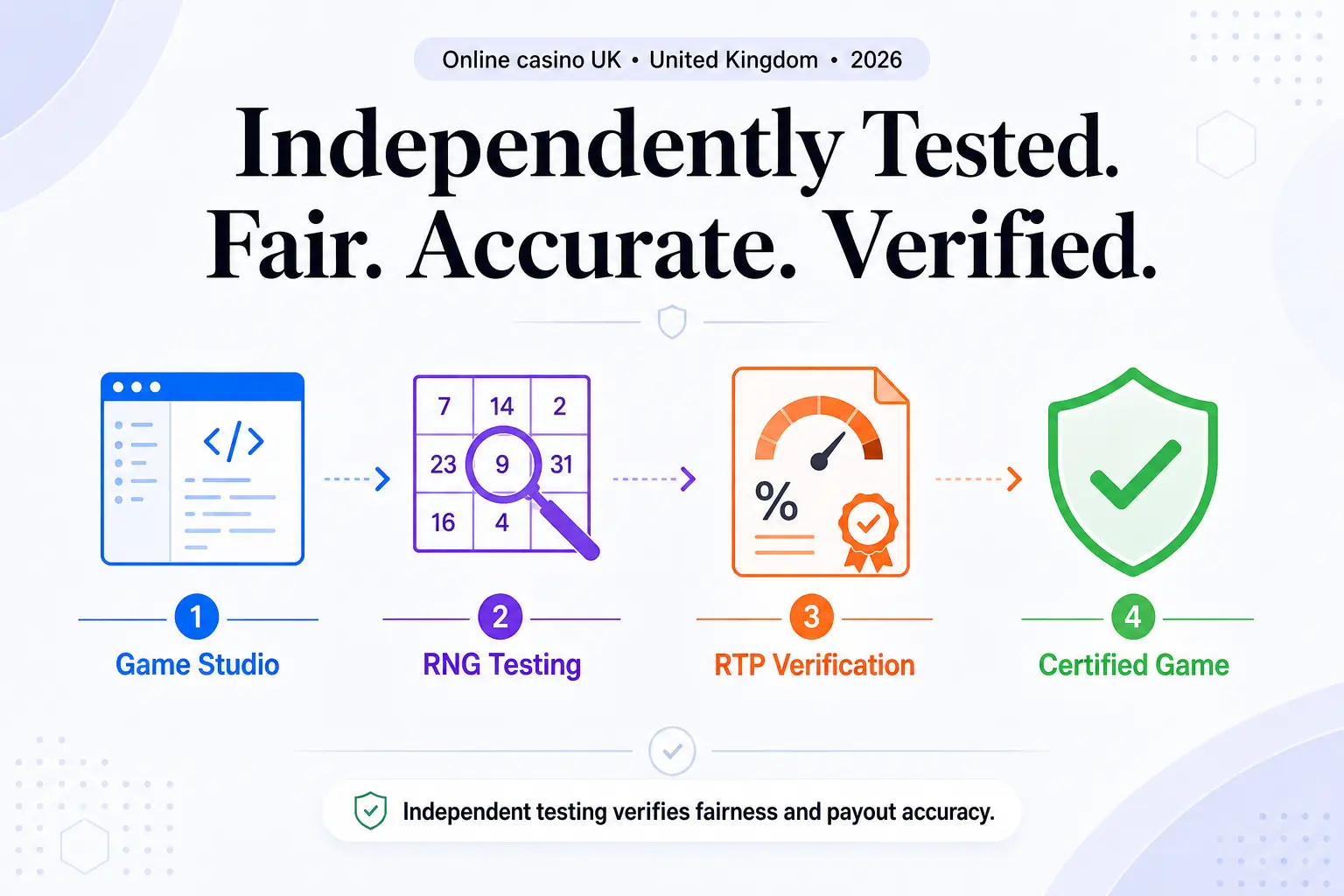
Independent testing can provide additional assurance about RNG behaviour, game mathematics and technical compliance, but certification must be interpreted in context. Laboratories such as GLI, eCOGRA, BMM and Quinel perform testing in regulated markets, while the applicable requirements depend on the jurisdiction in which the game is supplied.
A tested game does not certify the casino's withdrawals, customer support or treatment of player balances. For a Non GamStop operator, software checks should therefore sit alongside licence verification, KYC rules, withdrawal limits and dispute procedures. A strong provider catalogue is useful, but it cannot compensate for unclear ownership or regulatory information.
Payment Authentication and Transaction Risks at Non GamStop Casinos
Non GamStop casinos may support e-wallets, cryptocurrency, prepaid vouchers and bank transfers alongside conventional card payments. These methods use different authentication, settlement and record-keeping processes, but none should be treated as automatically anonymous or exempt from financial checks.
How Alternative Payment Methods Are Processed
The payment method affects what information is shared with the casino and how a transaction is authorised, but banks, wallet providers and payment processors can still retain transaction records and apply fraud or compliance checks.
Payment Channel
Authentication
Typical Deposit Speed
Key Consideration
Cryptocurrency
No card 3DS; wallet and blockchain confirmation apply
Minutes to longer during network congestion
Transactions are traceable and transfers can be irreversible
E-Wallets
Wallet login, verification or payment authentication may apply
Often immediate after approval
Deposit and withdrawal availability can differ
Prepaid Vouchers
No card authentication for the voucher itself
Usually immediate
Often deposit-only with separate cashout method required
Bank Transfers
Bank authentication and transaction monitoring apply
Method-dependent
Sender details and transfer records remain visible
Card authentication should be considered separately. Strong Customer Authentication can require additional verification for electronic payments, while permitted exemptions depend on factors such as transaction risk and the payment provider's controls. A casino should therefore not be described as offering a general “3DS exemption”.
There is also an important regulatory difference: UKGC-licensed gambling businesses cannot accept credit card gambling payments in Great Britain, including credit card funds routed through e-wallets. An offshore cashier displaying a credit card option should not be interpreted as providing the same protections or operating under the same UKGC payment rules.
Chargebacks, Payment Disputes and Fraud Risks
Payment Risk
Possible Impact
What to Check
Unauthorised Card Payment
Disputed transaction or account restriction
Contact the payment provider promptly and preserve records
Authorised Bank Transfer
Recovery may be difficult after funds are sent
Verify operator and payment details before transfer
Crypto Transfer
Incorrect transfers may be irreversible
Check wallet address, asset and blockchain network
Casino Withdrawal Dispute
Payment can remain pending or be refused
Check KYC, withdrawal terms and applicable dispute route
If a withdrawal exceeds the casino's published timeframe, save the withdrawal reference, applicable terms, KYC requests and relevant correspondence. Contact the operator through its formal complaints channel and request a written explanation rather than repeatedly cancelling and resubmitting the withdrawal.
External escalation depends on the casino's actual licence. MGA-licensed operators must provide a player dispute procedure and an appointed ADR entity. The MGA can also receive regulatory complaints, but the relevant ADR body handles the merits of player disputes. eCOGRA should therefore be mentioned only when it is the ADR provider appointed for that operator, not as a universal route for offshore casinos.
For other offshore licences, confirm the regulator, legal operator and complaint procedure before sending documents or paying any supposed recovery fee. If a transaction appears fraudulent, contact the relevant bank or payment provider promptly and use the current UK fraud-reporting service where appropriate.
Withdrawal Disputes and Complaint Routes at Non GamStop
Withdrawal delays, account restrictions and bonus disputes at offshore casinos should be handled through the operator's documented complaints process first. If the issue remains unresolved, the next step depends on the casino's actual licence and the independent dispute route available under that jurisdiction.
1
Step 1: Submit a Formal Complaint and Preserve Evidence
Start with the complaint procedure published in the casino's terms rather than relying only on live chat. Explain the disputed amount, transaction date, payment method and requested resolution, and ask the operator to confirm its position in writing.
Keep withdrawal references, account statements, relevant bonus terms, KYC requests, emails and chat transcripts. Screenshots showing the balance, withdrawal status or account restriction can also be useful, particularly if the casino later changes information displayed in the cashier.
Follow the operator's published response period and avoid repeatedly cancelling and resubmitting the same withdrawal. If additional verification is requested, record what was requested and when the documents were supplied. Never send passwords, wallet recovery phrases or unrelated financial information.
Before escalating further, identify the legal company, licence number and regulator shown in the casino's terms. A familiar brand name or licence logo is not enough if the licence cannot be connected to the company and domain involved in the dispute.
2
Step 2: Use the Dispute Route Attached to the Licence
There is no single UK gambling ombudsman for casinos outside GAMSTOP. The appropriate escalation route is determined by the offshore operator's licensing jurisdiction and its published complaints procedure.
For an MGA-licensed casino, the operator must maintain an internal complaints procedure and appoint an Alternative Dispute Resolution entity. Player disputes should normally be referred to that named ADR provider after the internal process has been exhausted. The Malta Gaming Authority's Player Support Unit can receive regulatory complaints, but it should not be treated as the operator's ADR service.
Current Curaçao Gaming Authority licence conditions also require a complaints procedure and access to ADR. For a Curaçao-licensed site, verify the licence holder and domain first, then use the dispute route identified in the operator's terms. Other offshore jurisdictions can use different procedures, so do not assume that eCOGRA or another organisation handles every Non GamStop casino.
Third-party complaint platforms may offer mediation, but they are separate from formal regulatory ADR unless the operator has specifically appointed that organisation. If an offshore site has no identifiable regulator, ADR provider or meaningful complaints process, recovering disputed funds can be considerably more difficult. For suspected fraud or a disputed payment, contact the relevant bank or payment provider separately and keep the casino complaint record intact.
Mobile Access at Non GamStop Casinos
Offshore casinos can be accessed through responsive websites, progressive web apps or downloadable mobile applications. The best option depends less on whether an app exists and more on whether the mobile version provides the same cashier, KYC, withdrawal, account-control and support functions as the desktop site.
Browser, PWA and Casino App Options
Mobile Format
Main Advantage
What to Check
Responsive Browser
No installation required
Cashier, games and account tools work fully on mobile
Progressive Web App
Home-screen access with browser-based installation
Official domain and update behaviour
Dedicated App
Native interface and device notifications
Official publisher, permissions and current version
Android APK
Direct installation outside an app store
Download source, file authenticity and requested permissions
For casinos outside GAMSTOP, a browser version is often the simplest option because it avoids installing additional software and normally updates automatically. A PWA can provide similar home-screen access while remaining linked to the casino's web platform. Dedicated apps may also be available, but players should confirm that the download comes from the operator's official domain or verified store listing.
APK downloads need additional care. An offshore casino may distribute an Android installation file directly when it is not available through a conventional app store. Before installing it, verify the domain, publisher information and permissions requested by the application. A casino app should not need unrelated access to contacts, messages or other sensitive device functions.
Mobile banking should also be checked separately from desktop access. Some payment methods may appear only on certain devices, while e-wallet, bank-transfer, Apple Pay or Google Pay availability depends on the operator and payment processor. More importantly, the mobile cashier should clearly show pending withdrawals, transaction limits, verification status and any documents still required.
Usability matters most when it affects account control. Balance information, deposit and withdrawal limits, self-exclusion settings, support and transaction history should remain easy to reach on a smaller screen. If these functions are hidden while games and deposits are prominent, the mobile experience is less useful regardless of loading speed or visual design.
Responsible Gambling and Support in Great Britain
Gambling should be treated as entertainment, not as a way to make money. Set a spending limit before you play, avoid chasing losses and do not use money needed for bills or other essential costs. If gambling is becoming difficult to control, free support, self-exclusion and specialist treatment services are available.
Support, Treatment and Self-Exclusion
GamCare:free and confidential support for people affected by gambling harm. The National Gambling Helpline is available 24 hours a day on 0808 8020 133, with live chat and other online support also available.
GAMSTOP:a free online self-exclusion service that restricts access to gambling websites and apps operated by companies licensed to provide remote gambling to consumers in Great Britain.
NHS Gambling Support:information about gambling-related harm and specialist treatment. In England, NHS gambling treatment services accept people experiencing gambling harm, with self-referral available through specialist clinics.
Gambling Commission:official information about online and land-based self-exclusion schemes, including GAMSTOP for online gambling and SENSE for licensed land-based casinos.
Non GamStop Casinos: Frequently Asked Questions in 2026
Can You Use a VPN at Non GamStop Casinos?
Using a VPN is not generally prohibited in the UK, but it does not change a casino's licensing status or make a restricted player eligible to use the site. Offshore operators may prohibit VPNs when they are used to disguise a player's real location or bypass territorial restrictions.
If the casino detects a location mismatch, it may suspend the account and request additional identity, address or payment verification. A withdrawal or bonus can also be affected where VPN use breaches the operator's terms. Check the restricted-country and VPN rules before registering rather than using location-masking tools to bypass them.
Is Your Data Safe at Non GamStop Casinos?
Data protection varies between offshore casinos, so a licence badge alone is not enough. Check whether the site uses encrypted connections, identifies the company responsible for personal data, explains how KYC documents are stored, and names the payment providers handling transactions.
Privacy requirements also depend on the operator's location and the laws that apply to its customers. Before registering, review the privacy policy, retention rules, account-security options and procedures for accessing or deleting personal information. Avoid operators that provide no clear information about data handling or the company controlling your account.
Which Payment Methods Can I Use at Non GamStop Casinos?
Payment options vary between offshore casinos and can include debit cards, bank transfers, e-wallets, prepaid methods and cryptocurrencies. Availability depends on the operator, payment provider, currency and player location, so check the cashier before depositing.
Also confirm the minimum deposit, fees, verification requirements and whether the same method supports withdrawals. Some deposit methods are deposit-only, while cashouts may need to use a bank account, e-wallet or another verified payment method held in your own name.
What Is the Difference Between Sticky and Non-Sticky Bonuses?
A non-sticky bonus usually keeps deposited cash separate from promotional funds. Depending on the terms, you may be able to withdraw your real-money balance before using the bonus, although doing so can cancel the promotion and any bonus-related winnings.
With a sticky bonus, the promotional balance is normally tied more closely to the account until wagering is completed or the bonus is cancelled. At casinos not on GamStop, check the wagering base, maximum bet, eligible games, expiry period and maximum cashout, as these rules vary between operators.
Do UK Players Pay Tax on Casino Winnings?
Casino winnings are generally not taxable for individual players in the UK. This normally applies whether gambling is occasional or regular and does not automatically change because winnings come from an offshore casino or a site outside GAMSTOP.
HMRC also states that gambling systematically or earning a living from betting does not by itself make the activity a taxable trade. Separate income from gambling-related services or business activities may be taxable, so these payments should be distinguished from the gambling winnings themselves.
Can I Play at Non GamStop Casinos on Mobile?
Yes. Most offshore casino sites work on iOS and Android through a responsive mobile browser, while some also provide a PWA or dedicated app. Browser access is usually the simplest option because it requires no separate installation.
Before using a casino app or downloading an Android APK, confirm that it comes from the operator's official website or verified store listing. The mobile version should provide access to the cashier, KYC documents, withdrawal status, account limits and support as well as the games themselves.
Why Can Withdrawals Take Longer at Non GamStop Casinos?
Delays can come from the casino's internal pending period, KYC checks, payment verification, bonus conditions or withdrawal limits. The payment method may be fast once approved, but the operator can still hold the request while account checks are completed.
If the stated timeframe has passed, contact the casino in writing and request the reason for the delay. Keep transaction records and verification receipts, then use the formal complaint or ADR route connected to the operator's licence if the issue remains unresolved.
Do Non GamStop Casinos Offer Deposit Limits?
Some casinos outside GAMSTOP provide daily, weekly or monthly deposit limits, but the available controls depend on the operator and licensing jurisdiction. Check the responsible gambling section before depositing to see which limits can be set directly from the account.
Also review how quickly decreases and increases take effect, whether limits cover all payment methods and whether cooling-off or self-exclusion options are available. If an active GAMSTOP exclusion applies, an offshore casino should not be used as a way to bypass it.
Editorial Standards and Independence
Our Non GamStop casino reviews follow a documented editorial process focused on operator identity, offshore licensing, player eligibility, KYC requirements, withdrawal limits, payment rules, bonus terms and dispute procedures. Where appropriate, the team also checks registration, cashier functions and withdrawal processes using controlled accounts. Commercial relationships do not determine ratings, and material licensing or payment concerns remain part of the review even when an affiliate partnership exists. We update pages when ownership, licences, restricted territories, withdrawal terms or other significant conditions change.
About Eleanor Whitmore
Eleanor Whitmore
Eleanor Whitmore is a UK casino review editor with more than nine years of experience covering online gambling sites, payment methods and bonus terms. For reviews of casinos outside GAMSTOP, she focuses on regulatory claims, licensing jurisdictions, KYC procedures, withdrawal conditions, player-protection tools and complaint routes rather than treating offshore status as a benefit on its own. She reviews evidence collected by the editorial team and helps distinguish verified information from operator claims that cannot be independently confirmed. Eleanor does not accept payment for changing ratings or removing material criticism.